


At Dr. Kelly's Surgical Unit, we understand that moment of panic when you discover an unexpected lump on your dog. Our surgical team evaluates hundreds of lumps and bumps every month across our Phoenix, Tucson, and Flagstaff locations, and honestly? We get it. That initial discovery can be overwhelming. Over our years of specialized surgical practice, we've helped thousands of Arizona pet parents navigate these concerns with confidence.
Let me share what we've learned from our extensive surgical experience. This guide will help you understand what you're dealing with when you find a growth on your dog—the same insights we give our clients every day. Whether it's a harmless cyst that just needs monitoring or something requiring immediate attention, we want you to feel informed and empowered to make the best decision for your furry family member.
Understanding the Basic Differences: What We Look For
After performing countless surgeries at Dr. Kelly's, we've developed a keen sense for distinguishing between different types of growths. Let me break down what we're actually feeling for when we examine your dog.
Cysts: The Common Culprits We See
You know what's interesting? About half the lumps we evaluate turn out to be simple cysts. These fluid-filled sacs develop when normal glands get blocked—basically, think of them as your dog's body creating a little balloon under the skin. We often tell our clients to imagine pressing on a tiny water balloon—that's exactly what most cysts feel like.
The majority we see are sebaceous cysts. Your dog's skin has thousands of oil glands, and sometimes they just get clogged up. During examinations, these feel soft and moveable, and honestly, we can often diagnose them just by touch. We see them everywhere on dogs' bodies, but they love showing up on heads, necks, and backs.
Follicular cysts are another regular visitor to our exam rooms. These develop from damaged hair follicles and feel firmer than sebaceous cysts. Here's something that might surprise you: when these rupture (and they sometimes do), that gross-looking discharge is actually pretty harmless. Many of our clients panic when they see it, but we usually just clean it up and send you home with some basic care instructions. No surgery needed!
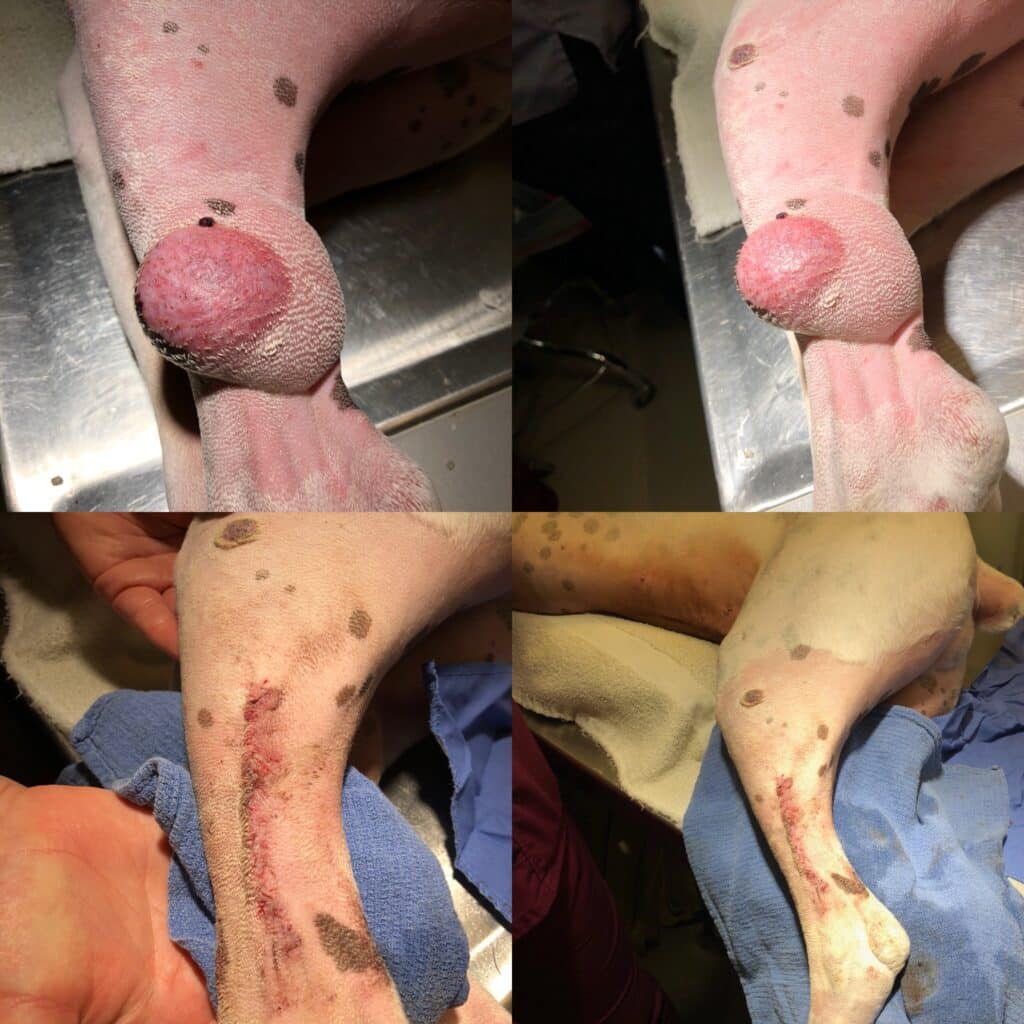
Tumors: When Our Surgical Expertise Matters Most
Now, tumors are a different story. Unlike cysts that are basically trapped gunk, tumors involve cells that are actively growing and multiplying. This is where our specialized training at DKSU really comes into play.
Benign tumors like lipomas? We remove dozens of these every month. They're fatty growths that feel soft and squishy, kind of like Play-Doh under the skin. While they won't spread through your dog's body, we've seen lipomas grow large enough to make walking uncomfortable, especially when they pop up near armpits or between the legs. The good news? Our surgical procedures for lipomas are routine, and your pup goes home the same day.
Malignant tumors require our most specialized skills. We've successfully removed mast cell tumors, fibrosarcomas, and melanomas that other clinics thought were too challenging. These cancerous growths often need what we call wide-margin excisions—basically, we take extra tissue around the tumor to make sure we get it all. It's precise work, but that's exactly what we've trained for.
Which Breeds See Us Most Often?
Through our years at Dr. Kelly's, we've noticed certain breeds walking through our doors more frequently for lump evaluations. It's not that these breeds are "doomed"—they're just genetically predisposed to certain types of growths, and knowing this helps you stay vigilant.
The Lipoma Club
Golden Retrievers and Labrador Retrievers practically have their own frequent flyer cards at our clinics. These loveable goofballs are incredibly prone to lipomas, especially as they hit middle age. We joke with owners that finding a lipoma on a 7-year-old Lab is almost a rite of passage. Cocker Spaniels, Dachshunds, and Weimaraners are also regular members of what we call the "lipoma club."
Interestingly, overweight dogs of any breed are more likely to develop these fatty tumors. That's one reason we're always harping on about maintaining healthy weight—besides all the other benefits, it might save you from multiple lipoma surgeries down the road.
The Cyst-Prone Pups
Certain breeds seem to have won the genetic lottery for sebaceous cysts. Cocker Spaniels (poor guys can't catch a break), Poodles, and their various mixes top our list. We also see tons of cysts on Schnauzers, Yorkshire Terriers, and Shih Tzus. These breeds have particularly active sebaceous glands, which means more opportunities for things to get clogged up.
Boston Terriers and Boxers frequently develop a specific type called follicular cysts, especially on their backs and sides. We've noticed these often appear after minor skin trauma or excessive scratching—another reason to stay on top of flea prevention!
The Cancer Watch List
This is the part where things get serious. Certain breeds have higher risks for malignant tumors, and we see these patterns play out in our surgery schedule every week.
Boxers, Bulldogs, and Boston Terriers (basically, the flat-faced crew) are unfortunately prone to mast cell tumors. We perform mast cell tumor removals on these breeds so frequently that we've developed specialized protocols just for them. Golden Retrievers, while amazing dogs, seem to be magnets for various cancers, including lymphoma and hemangiosarcoma.
Black dogs of any breed—but especially Black Labs, Rottweilers, and Scottish Terriers—have higher rates of melanoma. We pay extra attention to any dark-colored lumps on these pups, especially in their mouths or on their toes.
Here's the thing though: just because your dog is on this list doesn't mean they're destined for problems. It just means you should be extra diligent with those monthly body checks we recommend.
Key Characteristics: How We Evaluate Growths in Our Practice
When you bring your dog to DKSU for a lump evaluation, our systematic approach has been refined through thousands of examinations. Let me walk you through exactly what we're assessing.
Physical Features We Examine
After examining literally thousands of growths, our hands have become pretty good diagnostic tools. When I'm feeling a lump, I'm processing about ten different characteristics simultaneously.
Cysts have a distinctive feel—smooth edges, uniform shape, and that characteristic "give" when you press them. It really is like pressing on a small balloon. The skin over them usually looks totally normal, maybe just stretched if the cyst is large. Best part? They slide around freely when you try to move them.
Tumors are trickier. Benign ones like lipomas feel soft and doughy (think of cold butter under plastic wrap), while malignant tumors often feel firm or hard with irregular, bumpy surfaces. Here's a key difference we always check: can we move it freely, or does it feel stuck to the tissues underneath? Fixed growths that won't budge are a red flag that sends us straight to diagnostics.
Growth Patterns We Monitor
You'd be amazed how much the growth pattern tells us. We keep detailed records for every patient—measurements, photos, the works. This documentation has saved countless dogs from unnecessary surgeries (and saved their owners from unnecessary worry).
Cysts are pretty lazy. They might grow slowly for a while, then just... stop. We've monitored some cysts for years that never change size. Sure, they might get a bit bigger if they become inflamed or infected, but dramatic growth? Not their style.
Benign tumors like lipomas are predictable plodders. They grow steadily but slowly—maybe doubling in size over a year or two. We schedule several lipoma removals every week, and most of them have been growing gradually for months before the owner decides it's time.
But when we see rapid growth? That changes everything. A mass that doubles in size within two to three weeks gets our immediate attention. We'll often bump these cases to the front of our surgical schedule because early intervention can make such a difference in outcomes.
Red Flags: When We Recommend Immediate Action
Through our extensive experience at Dr. Kelly's Surgical Unit, we've identified specific warning signs that require urgent evaluation. If you notice any of these, don't wait for your regular checkup—call us immediately.
Urgent Situations We Prioritize
Our surgical schedule always has room for emergencies, and certain presentations automatically trigger our rapid response protocol.
Rapid growth is our biggest concern. Just last week, we had a Beagle whose owner noticed a small lump on Monday, and by Friday, it was the size of a golf ball. We got him in for surgery that afternoon. These aggressive tumors can become inoperable surprisingly quickly, which is why we never mess around with fast-growing masses.
Any lump that's bleeding, oozing, or developing an open sore needs immediate attention. Sure, sometimes it's just an infected cyst that burst (gross but manageable), but we've also caught aggressive cancers that initially looked like simple wounds. We'd rather see you and tell you it's nothing serious than have you wait and miss our window for successful treatment.
Pain is another major red flag. If your dog flinches when you touch the lump, constantly licks at it, or seems generally uncomfortable, we want to see them ASAP. I remember one case where a small, painful lump on a German Shepherd's leg turned out to be an aggressive nerve tumor. Because the owner brought him in immediately when he started limping, we were able to remove it completely.
Location Matters: High-Risk Areas We Watch Closely
After thousands of surgeries, we've learned that location can be just as important as the lump itself.
Oral tumors are some of our most challenging cases. Dogs can't tell us their mouth hurts, so these often go unnoticed until they're advanced. We check every patient's mouth during exams, but you should too—especially if you have a Boxer or Golden Retriever. Even benign growths in the mouth can interfere with eating, and malignant ones can spread quickly.
Mammary masses, particularly in unspayed females, always get our immediate attention. We've performed hundreds of mammary tumor removals, and early detection literally saves lives. Fun fact: male dogs can get mammary tumors too, though it's rare. We actually removed one from a male Poodle just last month!
Any lump appearing at a previous surgery or injection site deserves special scrutiny. While rare, injection-site sarcomas are aggressive and require extensive surgery. We track these carefully and always ask about your dog's vaccination and surgery history during lump evaluations.
Our Diagnostic Process at DKSU
When you bring your dog to one of our locations, we follow a systematic diagnostic approach that we've refined through years of surgical practice. Understanding our process helps you know exactly what to expect.
Our Comprehensive Examination Approach
The initial exam is more than just poking at the lump. We're conducting a full investigation, and every detail matters.
During palpation, I'm assessing size, shape, texture, temperature, and mobility. My fingers are also searching for other lumps you might not have noticed. Can't tell you how many times we've found additional small masses during routine exams. We also systematically check all the lymph nodes—if they're enlarged, it could indicate spread from a malignant tumor.
Your input is crucial here. When did you first notice it? Has it changed? Does your dog seem bothered by it? One client recently mentioned their dog had been "a bit off" for a week—turned out that seemingly unrelated lethargy was connected to an aggressive tumor we found. These details help us piece together the full picture.
We document everything with measurements and photos. This isn't just bureaucracy—it's how we track changes over time and make informed decisions about treatment.
Advanced Diagnostics We Perform
Our in-house diagnostic capabilities mean we can often get answers the same day you visit us.
Fine needle aspiration (FNA) is usually our first move. It's quick, most dogs don't even need sedation, and it gives us immediate information. I can't count how many worried owners I've been able to reassure within minutes: "It's just a lipoma, nothing to worry about!" But FNA has limitations—some tumors don't give up their secrets easily.
When FNA isn't conclusive, we move to biopsy. Our surgical team has perfected techniques for getting good tissue samples while minimizing discomfort. Yes, it means a small procedure, but the information we get is invaluable. We work with excellent pathologists who typically get results back to us within 48-72 hours.
For complex cases, especially when planning surgery, we might recommend imaging. X-rays can show if a tumor has spread to the lungs, while ultrasound helps us understand how deep a mass goes. This planning makes our surgeries more precise and successful.
Treatment Excellence at Dr. Kelly's
Our specialized surgical facility has developed refined protocols for treating both cysts and tumors. What sets us apart? Every single patient goes home the same day—we've structured our entire practice around this philosophy because we know dogs recover better at home with their families.
Our Approach to Cyst Management
Here's something that might surprise you: most cysts we see don't need surgery at all. After evaluating thousands of them, we've gotten pretty good at identifying which ones can be safely monitored versus which need intervention.
For cysts that aren't causing problems, we typically recommend what we call "watchful waiting." We'll measure it, photograph it, and ask you to keep an eye on it. Come back in six months, and often it hasn't changed a bit. This approach has saved countless dogs from unnecessary procedures.
But when cysts do need removal—maybe they're in an annoying spot, keep getting infected, or just bug the heck out of your dog—our technique ensures they don't come back. The key is getting the entire cyst wall out. Leave even a tiny piece behind, and you'll be seeing us again in a few months. Our surgeons have removed so many cysts that the procedure is almost automatic, typically taking less than 20 minutes.
For infected cysts, we might start with antibiotics and warm compresses. It's less exciting than surgery, but often just as effective. One of our regular clients calls this our "wait and see if it pops" approach—crude but accurate!
Our Surgical Excellence in Tumor Removal
This is where DKSU really shines. We're not your regular vet clinic doing occasional surgeries—we're a dedicated surgical unit performing multiple tumor removals every single day.
Benign tumor surgery is our bread and butter. Lipomas, in particular, are so routine for us that we've streamlined the entire process. Drop your dog off in the morning, we remove the tumor with minimal incision and precise technique, and you're picking up a slightly groggy but tumor-free pup by afternoon. Our spay and neuter services follow the same efficient, same-day model.
Malignant tumor surgery showcases our team's highest skills. We excel at wide-margin excisions—taking enough tissue to ensure complete removal while preserving as much normal function as possible. I've personally removed tumors other vets deemed inoperable, using techniques we've developed through years of specialized practice.
Cost is always a concern, and we get it. That's why we offer transparent pricing and CareCredit financing options. We've structured our practice to keep costs down without compromising quality. Early surgical intervention often costs less than managing complications from delayed treatment—something we've seen play out hundreds of times.
Prevention and Monitoring: Our Professional Recommendations
Based on our surgical experience across thousands of cases, we've developed monitoring protocols that catch problems early when they're easiest (and cheapest) to fix.
Preventive Strategies We Advocate
Look, we can't prevent every lump and bump, but there are definitely things you can do to reduce risks.
Spaying and neutering is huge. We perform these procedures daily at all our locations, and the cancer prevention benefits are real. Spaying before the first heat cycle virtually eliminates mammary cancer risk—we're talking about going from a 25% chance to almost zero. For males, neutering prevents testicular cancer (obviously) and reduces risks of certain perianal tumors. Plus, with our same-day discharge, your pet recovers at home where they're comfortable.
Weight management is another big one. Overweight dogs don't just get more lipomas—they're harder to examine properly. Can't tell you how many lumps we've found after dogs lost weight and we could actually feel through their skin properly. We're happy to discuss nutrition during any visit.
Regular professional exams complement your home monitoring. During routine visits, our trained hands often detect growths in early stages. We recommend annual exams for young dogs, twice yearly for seniors. Given how many lumps we evaluate daily, we've gotten pretty good at catching things early.
Home Monitoring Techniques We Teach
Every client gets our "lump check" tutorial. It's not complicated, but doing it consistently makes all the difference.
Monthly systematic body checks are key. Start at the nose, work your way back. Feel everywhere—behind the ears, under the jaw, armpits (lots of lumps hide there), along the belly, between the toes. Make it part of your grooming routine. One client does it during their dog's monthly bath, another during weekly brushing. Whatever works for you, just be consistent.
Photos are incredibly helpful. Use the same lighting, same angle, and always include something for scale (a coin works great). When clients bring these documentation photos to appointments, it makes our job so much easier. "Doc, look how much this has grown since last month!" Sure beats trying to remember if that lump was always that big.
Keep notes! Get a little notebook or use your phone. Date, location, size, any changes. This information is gold during veterinary visits. We've had cases where an owner's detailed notes helped us catch something serious early.
When to Call Dr. Kelly's Surgical Unit
After all this information, you might wonder when you should actually pick up the phone and call us. Here's our simple rule: when in doubt, reach out.
We'd rather see a hundred benign lipomas than miss one aggressive cancer. Seriously, we never get annoyed by concerned pet parents—that's literally what we're here for. Our team across all locations is trained to triage calls quickly. Describe what you're seeing, and we'll tell you if you need an immediate appointment or if it can wait for your regular checkup.
Some things always warrant an immediate call: rapid growth (anything doubling in size within two weeks), bleeding or ulceration, obvious pain or discomfort, lumps in high-risk areas (mouth, mammary glands, injection sites), or any lump accompanied by other symptoms like lethargy or appetite loss.
For everything else, our general timeline is: new lumps should be evaluated within 1-2 weeks, existing lumps with changes need reassessment within a few days, and stable lumps we're monitoring can wait for scheduled rechecks.
Our Commitment to Your Pet's Health
At DKSU, we've built our entire practice around one principle: providing exceptional surgical care while keeping it accessible and stress-free for both pets and their people.
We know finding a lump on your dog is scary. We've been there ourselves with our own pets. That's why we take time to explain everything, show you what we're seeing, and make sure you understand your options before moving forward. No pressure, no judgment—just honest, expert advice based on thousands of similar cases.
Our same-day surgery policy isn't just convenient—it's better medicine. Dogs recover faster at home, surrounded by familiar smells and their favorite people. We've refined our techniques and protocols to make this possible while maintaining the highest surgical standards.
Whether you need our surgical expertise for a complex tumor removal or just want peace of mind about a suspicious bump, we're here for you. With locations throughout Arizona and expanding services, we're making specialized surgical care accessible to more pets than ever.
Don't let worrying about a lump keep you up at night. Contact Dr. Kelly's Surgical Unit today to schedule an examination. Our experienced team is ready to provide the answers you need and the surgical excellence your pet deserves. Together, we'll ensure your furry family member gets the right care at the right time, whether that's careful monitoring of a harmless cyst or expert removal of a concerning tumor.
Remember, early detection and intervention make all the difference. The sooner we evaluate that lump, the more options we have. Call us today—your dog (and your peace of mind) will thank you.
